The Sovereign Vision Protocol:
Clean the Filter, Upgrade the Hardware
Your eyes are not biological cameras. They are exposed brain tissue — the only part of your central nervous system that sits outside the skull, directly exposed to the environment. When vision begins to fail, the medical system hands you glasses or drops and sends you back to your screens. But vision loss is not aging. It is a hardware failure. And it almost always begins in the liver.
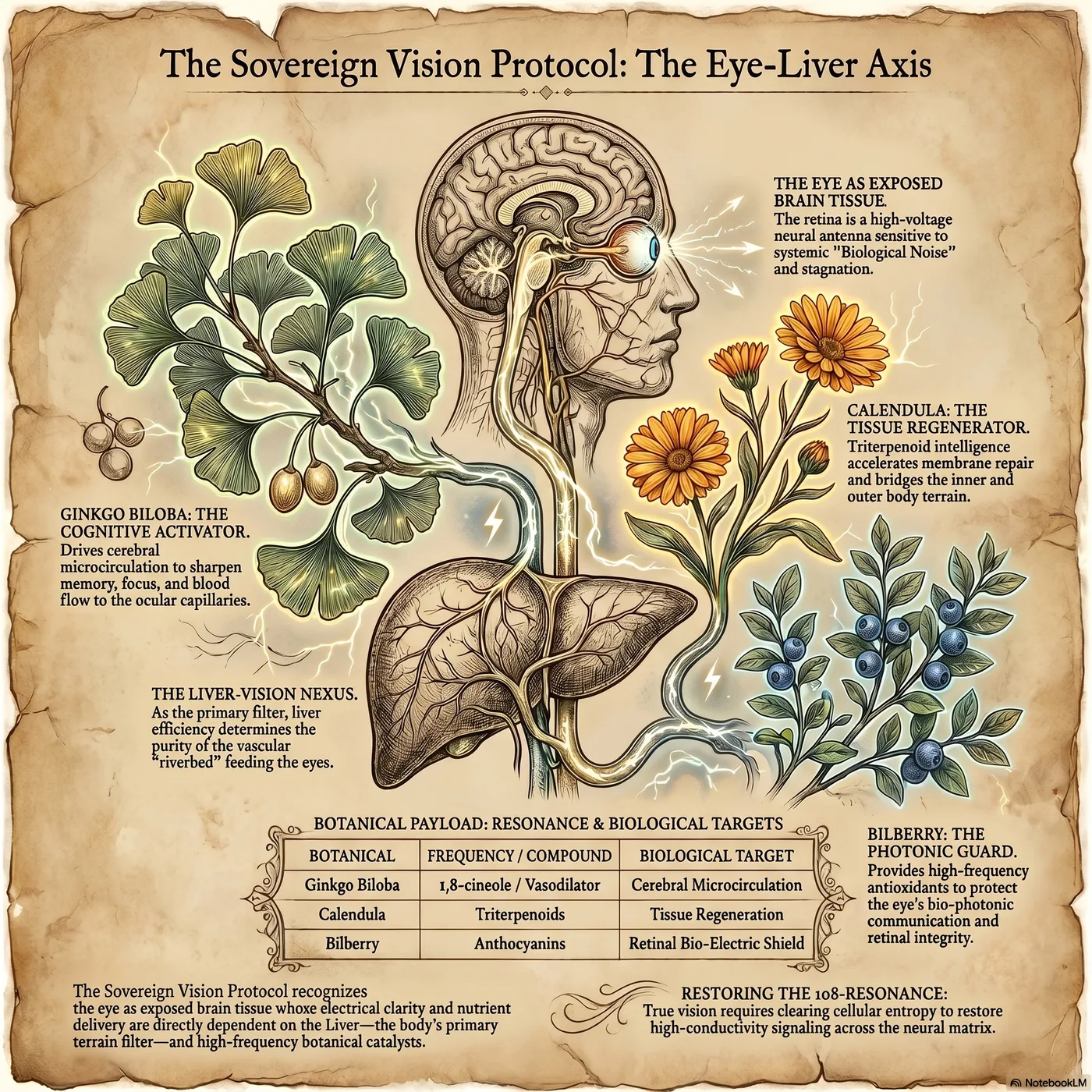
The Hidden Root: Your Liver Opens Into Your Eyes
Ancient traditions — Chinese medicine, Ayurveda, European humoral medicine — all identified the same relationship: the liver governs the eyes. This was not metaphor. It was clinical observation accumulated over millennia, before the language of biochemistry existed to explain why.
Today, biophysics has the explanation. Your liver is the primary blood filter. Every litre of blood passing through your body cycles through the liver for filtration, hormone processing, and toxin conjugation. When the liver becomes congested — overloaded with processed fats, alcohol residues, pharmaceutical metabolites, synthetic hormones, and environmental pollutants — the quality of the blood it circulates degrades.
The first casualty is always the smallest capillaries. And nowhere in the human body are the capillaries more microscopic, more high-pressure, or more dependent on clean blood than in the retina.
The terrain link: Retinal capillaries are among the narrowest blood vessels in the body — many only one red blood cell wide. Elevated blood viscosity from a congested liver, combined with inflammatory compounds the liver failed to neutralise, causes these capillaries to stiffen and narrow. The result: reduced oxygen and nutrient delivery to the photoreceptors, progressive retinal dysfunction, and rising intraocular pressure. This is the mechanism behind most age-related vision decline — and it begins in the liver, not the eye.
The Modern Acceleration
This mechanism has always existed. What has changed is the scale of the liver load and the scale of the ocular assault.
The modern liver is processing a toxin load it was never designed to handle: 80,000+ synthetic chemicals in the food and water supply, hormonal residues from industrial meat and plastics, pharmaceutical polypharmacy, seed oils that clog the bile ducts and block fat-soluble vitamin absorption. The modern eye is simultaneously subjected to approximately 10 hours per day of blue-spectrum LED light from screens — a wavelength that generates free radicals directly in the macula, accelerating photoreceptor degeneration at a rate no previous generation experienced.
Two simultaneous attacks: one from below (a congested filtration system delivering inflammatory blood to the retina), one from above (direct oxidative assault on the photoreceptors from artificial light). The medical solution addresses neither. It compensates for the degraded output with corrective lenses and does not touch the root.
The Sovereign Vision Protocol addresses both simultaneously — from the liver up, and from the photoreceptors down.
The Sovereign Vision Protocol — Six Stages
Stage 1 — The Hydraulic Pump
Ginkgo Biloba + Bilberry
Before any other intervention can work, circulation must be restored to the optic nerve and retina. Ginkgo Biloba (standardized extract, 24% flavone glycosides) forces microcirculation into the deep capillary beds — including the retinal and choroidal vessels — through its dual action of platelet inhibition and vasodilatation. Bilberry (Vaccinium myrtillus) strengthens the capillary walls themselves, increasing elasticity and reducing permeability. Together they function as a hydraulic pump: Ginkgo drives the pressure, Bilberry seals the pipes.
- Ginkgo Biloba: 120mg standardized extract, morning with breakfast
- Bilberry: 160mg standardized extract, morning with breakfast
- Note: Both herbs are mild anticoagulants. Do not combine with pharmaceutical blood thinners without monitoring.
Stage 2 — The Optical Shield
Calendula (Marigold)
Calendula officinalis is the primary macular shield in the botanical pharmacopoeia. Its flowers contain the highest plant-source concentrations of lutein and zeaxanthin — the two carotenoid pigments that constitute the macular pigment optical density (MPOD) layer. This pigment layer is the eye's primary filter against blue-light radiation. In virtually every case of age-related macular degeneration, MPOD is severely depleted. Consistent daily Calendula supplementation rebuilds this layer over weeks and months, restoring the eye's native solar defence.
- Daily: 300mg Calendula extract, or 1–2 cups of Calendula flower tea
- Duration: Minimum 8 weeks to observe measurable MPOD change
Stage 3 — The Signature Software
Eyebright (Euphrasia officinalis)
Eyebright is one of the clearest examples of the doctrine of signatures in the botanical tradition — its flower bears an unmistakable resemblance to the human eye. This is not coincidence. Euphrasia has a direct affinity for ocular tissue that clinical herbalism has documented for centuries. Its iridoid glycosides and flavonoids reduce intraocular pressure, strengthen the conjunctiva, stabilise the tear film, and reduce chronic ocular surface inflammation — the persistent, low-level irritation that precedes serious degeneration. In the terrain model, Eyebright resets the signalling software of the eye back toward its native parameters.
- Daily: 400mg Eyebright extract, or 2 cups of tea
- Acute eye strain: 1–2 drops diluted tincture as an eye wash (always dilute in sterile water)
Stage 4 — The Neural Shield
Astaxanthin
Astaxanthin is not an herb — it is a marine carotenoid produced by microalgae, the same pigment that makes salmon pink and flamingos red. It is, by any measurable standard, the most potent antioxidant available for ocular tissue. Its unique molecular structure allows it to span the full width of the cell membrane, providing protection both inside and outside the cell simultaneously — a capability no other carotenoid possesses. Critically for vision, Astaxanthin crosses the blood-retinal barrier directly, reaching the photoreceptor layer and the optic nerve ganglion cells where other antioxidants cannot penetrate. Studies show measurable reduction in retinal fatigue, improved visual acuity, and reduced macular degeneration progression at 6–12mg daily.
- Daily: 6–12mg with the largest fat-containing meal of the day
- Essential: Fat is required for absorption — do not take on an empty stomach
- Timeline: Minimum 4 weeks for measurable effect; 12 weeks for maximum tissue saturation
Stage 5 — The Transdermal Patch
Castor Oil + Pearl Powder
While the internal protocol saturates the terrain from within, Stage 5 delivers intervention directly to the orbital tissue from outside. Cold-pressed Castor oil applied to closed eyelids penetrates the thin eyelid skin and acts on the Meibomian glands — the oil-secreting glands of the eyelid that produce the outer lipid layer of the tear film. Dysfunction of these glands is the primary cause of dry eye syndrome and chronic blepharitis. Castor oil also stimulates lymphatic drainage in the periorbital tissue, clearing the stagnant lymphatic congestion that accumulates around eyes spending 10+ hours in screen-lock. Pearl powder (a marine silica compound) taken internally provides the silica matrix that the vitreous humour and lens depend on for optical clarity.
- Evening: 2–3 drops cold-pressed Castor oil on clean closed eyelids, leave for 10–15 minutes, blot gently
- Internal: 500mg Pearl powder with water, morning or evening
Stage 6 — Kinetic Recalibration
Sunning + Palming
The final stage costs nothing and is the oldest vision protocol in existence. Sunning — exposing closed eyelids to direct sunlight while slowly rotating the head — provides the photoreceptors with the full-spectrum light signal they evolved to receive. The pineal gland receives light through the retina; sunning stimulates melatonin synthesis and resets the circadian rhythm that governs retinal repair during sleep. Palming — pressing warm, cupped hands over closed eyes in total darkness for 5 minutes immediately after sunning — allows the ciliary muscle (the lens-focusing muscle responsible for most myopia progression) to fully release accommodation tension. Chronic screen exposure locks this muscle in sustained near-focal contraction. Palming is the counterforce. Together, these two practices are kinetic calibration — resetting the hardware through movement and light rather than through chemistry.
- Daily: 5 minutes sunning — sun on closed eyelids, slow side-to-side rotation of the head. Never stare directly at the sun.
- Immediately after: 5 minutes palming — warm, cupped hands over closed eyes, full darkness, full relaxation
- Timing: Morning sunlight (first 2 hours after sunrise) is optimal for circadian resetting
The Liver First
The six stages above address the optical hardware directly. But the protocol is incomplete without the upstream fix: cleaning the filter.
If the liver remains congested, the inflammatory blood it circulates will continue to degrade the retinal capillaries faster than the botanical protocol can repair them. The terrain principle holds: you can sharpen the instrument all you want, but if the environment that instrument operates in remains hostile, maintenance will always lose to degeneration.
For meaningful vision restoration, the Sovereign Vision Protocol should be run concurrently with the Sovereign Gut Protocol (SGP) — specifically the first two stages: the bile flush with Dandelion Root and Artichoke Leaf, and the mucosal seal with Marshmallow Root and Licorice. These two stages directly decongest the liver-bile-gut axis, improving blood quality upstream of every capillary bed in the body — including the one your retina depends on.
The complete sequence: SGP Stage 1 & 2 (liver/bile flush) → VISION Stage 1 & 4 (Ginkgo + Astaxanthin) running daily as the baseline → VISION Stage 2 & 3 (Calendula + Eyebright) as daily support → VISION Stage 5 each evening (Castor oil patch) → VISION Stage 6 each morning (sunning + palming). This is not a two-week course. This is a terrain baseline — maintained indefinitely for anyone who works in front of screens.
The Doctrine
The medical Matrix offers two solutions for failing vision: corrective lenses that compensate for the degraded output without touching the root, and pharmaceutical drops that manage intraocular pressure without addressing why it rose. Both are symptom management. Neither is terrain restoration.
Your photoreceptors are neurons. They regenerate on the same biological principles as every other neural tissue — given the right substrates, circulation, and light signal. The liver-eye axis is not ancient wisdom grafted onto modern physiology. It is ancient observation now confirmed by every retinal imaging study that shows the microvasculature changes in eyes that correlate directly with markers of hepatic overload.
Clean the filter. Restore the circulation. Shield the photoreceptors. Recalibrate the hardware. This is what it means to operate with sovereign vision.
Sovereign Sourcing
The botanicals in the Sovereign Vision Protocol are available via Amazon. These are affiliate links — a small commission supports the platform at no extra cost to you.