The Lyre and the Pact
In 1570, John Dee sat down to warn his readers before he taught them anything. He told them about Plato — how students flocked to his school, drawn by his fame, only to leave disillusioned once they understood where his teaching actually led. Not to wealth. Not to health. Not to worldly advancement. Plato's whole doctrine, his listeners finally realized, converged on one thing: the Unum, the Bonum, the Ens — the One, the Good, Being itself — "Spirituall, Infinite, Æternall, Omnipotent." When they grasped that this was the destination, Dee writes, "straightway the fantasies of those hearers were dampt... his doctrine was by them despised: and his schole, no more of them visited." Dee tells this story as a forewarning. He is about to do the same to his own reader. This is that same warning, four hundred and fifty-six years later — followed by the part of the story Dee could not have told about himself.
The man behind the glyph
History flattened John Dee into "the Queen's conjurer." The record shows something wider. Born in London in 1527, he was invited, still in his early twenties, to lecture on Euclid at the University of Paris. He was a mathematician and astronomer, and from the 1550s to the 1570s he advised the voyages of English navigators with technical instruction and political argument; he is usually credited with first using the phrase "British Empire." When Elizabeth came to the throne in 1558 he chose the date of her coronation. In 1583 she asked him about the new Gregorian calendar; he advised England to adopt it, with seven amendments. England refused, and kept the old calendar for another 170 years. His house at Mortlake held what was described as the greatest private library in England.
Elizabeth came to that house. On 16 March 1575 she arrived to find that Dee's first wife had died that day and was about to be buried; she would not enter, and spoke with him by the churchyard wall instead. On 17 September 1580 she came again, and a few weeks later asked him which overseas lands, Greenland and Newfoundland among them, she could lawfully claim. His own diary for 28 November 1577 reads: "I declared to the Quene her title to Greenland, Estetiland and Friseland." Whether she took any interest in the angels he would later consult, the record does not say. It does show a queen who kept coming back to his door.
Then there is the part that cannot be proven, because it was never meant to be. In the autumn of 1578 the diary records that "the Erie of Lecester and Sir Francys Walsingham, secretary, determined my going over for the Quene's Majestie," and that on 4 November he was "directed to my voyage" by the two of them. Five days later he went to sea, and by 14 November he was in Hamburg. Leicester and Walsingham were the men who ran Elizabeth's affairs of state and intelligence. The diary does not say what the errand was. A scholar who travels the continent, corresponds across Europe, and can be sent abroad as a mathematician or an astrologer makes an ideal cover for a secret agent. Was he one? There is no document, and an agent who leaves documents has failed at his work. What the sources do show is a man who stood close to the people who ran the secret side of Elizabeth's government, and who was trusted to cross the sea on their instruction.
Four witnesses, one structure
History flattened John Dee into "the Queen's conjurer" — crystal balls, a colorful footnote to Elizabethan intrigue. What actually survives in his own hand is more demanding than that. It is a single claim about the structure of reality, built four separate times, in four completely different registers of thought, across twenty-six years — without him ever repeating himself, and without any indication he noticed he was drawing the same shape twice.
The world as an instrument
Propaedeumata Aphoristica, 1558Dee is thirty-one. His first printed book opens with creation and conservation treated as the same divine exception to natural law:
"As God created all things out of Nothing, against the laws of reason and Nature: so can nothing of the created ever pass away into nothing, unless it happen, against those same laws, through the supernatural power of God himself."
A few pages later, the book's real argument arrives — a physics of total interconnection:
"Whatsoever exists in actuality casts rays in every direction into every part of the world, and these rays, in their own way, fill the whole universe. Hence every place in the world contains the rays of everything that actually exists within it."
And then the image Dee is actually remembered for, when he's remembered at all:
"This world is as it were a lyre, tuned by some most excellent Craftsman: its strings are the individual things of this universe — and whoever knows how to touch and strike them rightly will draw forth wonderful harmonies."
Harmony, the next aphorism adds, does not arrive despite the friction between things — the sympathy and antipathy between parts — but through it, toward "the agreement and union of the Whole." The 120 aphorisms on rays, magnets, and celestial influence end with four Latin words, the only ones that mattered to him: SOLI DEO HONOR ET GLORIA. To God alone, honor and glory.
The point that is also the sun
Monas Hieroglyphica, 1564Six years later, Dee publishes a single glyph, constructed across twenty-four geometric theorems — point, to circle, to cross. Theorem III makes the claim explicit: the point at the exact center of the glyph is simultaneously Earth and Sun. Not two symbols for two things. One point, two names. The entire treatise is Dee working out, in pure construction, what it means for unity to underlie apparent duality.
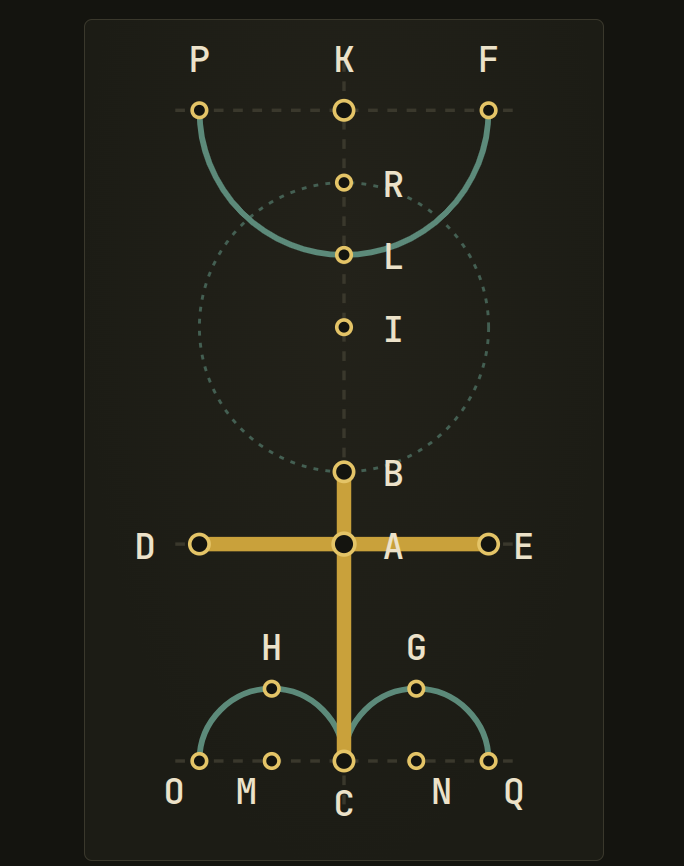
The Monas Hieroglyphica's Theorem XXIII construction, rebuilt to exact proportion from Dee's own text — AB:AC:AD:AE in the ratio he specifies, CK = 9. The figure Dee himself calls, in his closing theorems, the birth of the stone "through Art."
A — the construction's starting point, the figure's "waist."
B — one unit toward the head; C — three units toward the foot.
D, E — the crossing arms, two units each.
I, R, K — auxiliary points continuing from B up to the crown at K, six units from A in total.
P, F, L — the large ornamental arc crowning K.
M, N, O, Q, H, G — the two smaller ornamental arcs at the foot, C.
AB (1) + AD/AE (2) + AC (3) = CK (9), as Dee himself states for the full span. Dashed lines are Dee's own construction lines; the solid cross is the result. Verified directly against Dee's printed figure (Frankfurt 1591, p. 91), not the text alone.
Mathematics as the bridge
The Mathematicall Praeface, 1570In his preface to the first English Euclid, Dee lays out his full ontology. Everything that exists falls into three kinds:
"All thinges which are, & haue beyng, are found vnder a triple diuersitie generall. For, either, they are demed Supernaturall, Naturall, or, of a third being... A meruaylous newtralitie haue these thinges Mathematicall, and also a straunge participatiõ betwene thinges supernaturall... and thynges naturall."
Mathematics, for Dee, is not abstraction. It is a literal third kind of being — a bridge-substance between God and matter, partaking of both. Defining the basic unit of number, he reaches for the exact word he had carved into his own glyph six years earlier:
"Note the worde, Vnit, to expresse the Greke Monas, & not Vnitie."
Then the sentence that should stop any reader:
"For his Numbryng, then, was his Creatyng of all thinges. And his Continuall Numbryng, of all thinges, is the Conseruation of them in being."
God does not use numbers. God's act of creating — and of continuing to hold the world in existence — is numbering. And before any of it existed, Number itself — specifically the self-moving Number Dee identifies with the human soul — "had perfect beyng, in the Creator, Sempiternally." Eternally present in God, before creation.
The same structure, from the other side
Recorded spirit conversations, 1580sA decade later, in the 1580s, Dee is recording what he believed were direct angelic communications, spoken through the medium Edward Kelley (the next section is about him). In Kraków, on 12 April 1584, the same architecture reappears — unprompted, from a completely different direction. First, a teaching on eternal Ideas:
"Every Idea in eternity is become for ever, and what is thought, is become a living creature."
Then, in the same sitting, a geometric exposition on a round table called "the body of all things":
"The substance is attributed to God the Father. The first circular mover, the circumference, God the Son... The order and knitting together of the parts in their due and perfect proportion, God the Holy Ghost."
Point. Circle. Cross. The exact sequence of the Monas, twenty years later, spoken through a crystal by a man with no obvious reason to be recalling his own geometry textbook. Earlier, the same recurring spirit — called Madimi — had already said it more plainly still:
"God is the unity of all things... For love is the Spirit of God uniting and knitting things together in a laudable proportion."
Four sources. Physics, geometry, philosophy, revelation. 1558 to the 1580s. One structure, every time: a single Source; a mediating principle — ray, number, love, spirit — that binds everything into one; unity expressed through multiplicity, never despite it; and everything, eternally, already present in that Source before it ever appeared as a separate thing. He built it four times and never once stepped back to notice he was drawing the same shape.
The seer
Edward Kelley came to Dee's door in 1582 calling himself Edward Talbot. He was a young man with trouble behind him: the seventeenth-century writer John Weever says he lost his ears in the pillory at Lancaster, though Charles Nicholl, who has studied the sources more closely than anyone, finds evidence for one ear, first mentioned in 1593. What mattered to Dee was something else. For years he had tried to speak with angels and had not been able to. Kelley could see. He sat before a crystal, described what appeared in it, and Dee wrote down every word. The partnership ran for seven years.
What came through was a language, which Dee called Angelical: the tongue the angels spoke, and the one Adam knew before Babel. Only in the nineteenth century did occultists rename it Enochian. The sessions produced the Calls, lettered tables, and a Holy Table with wax seals under its legs. In September 1583 Dee and Kelley left England and began a nomadic life in Central Europe, with audiences before King Stephen Báthory in Poland and Emperor Rudolf II in Prague, whom Dee tried to convince that the angels mattered. Meric Casaubon printed Dee's records in 1659 as A True & Faithful Relation, and in his own index he says he publishes them so that readers "may be warned by such sad examples, not to hunt after new doctrines, and pretended inspirations and revelations." Ceremonial magic, all the way to the Golden Dawn, grew out of the book he meant as a warning.
The pact
Here is where it has to turn, because stopping above would be a lie by omission.
In April 1587, at Třeboň in southern Bohemia, the voices changed their message. Kelley reported that Madimi, the same spirit who had said God is the unity of all things, now commanded that the two men hold everything in common. Including their wives. Kelley resisted. On 11 April he signed a declaration that, whatever the voices wanted, he was finished: "I will from this day forward meddle no more herein." The sessions went on anyway. Dee wrote that when Kelley brought him the instructions, "I greatly rejoiced in spirit, and was utterly resolved to obey this new Doctrine."
Then he went to tell his wife. We have his own account, printed in Casaubon. After midnight, having heard Kelley's reports, Dee went to bed and found Jane awake, waiting to hear the news. He told her: "Jane, I see that there is no other remedy, but as hath been said of our cross-matching, so it must needs be done."
"Thereupon she fell a weeping and trembling for a quarter of an hour: and I pacified her as well as I could; and so, in the fear of God, and in believing of his Admonishment, did persuade her that she shewed herself prettily resolved to be content for God his sake and his secret purposes to obey the Admonishment."
In the very next lines he writes this, about his own seer: "Because I have found so much halting and untruth in E.K. his reports to me made, of the spiritual creatures, where I have not been present at an Action... I believe so much hereof as shall by better trial be found true." He knew the source was unreliable. He overrode his wife on its word anyway.
The covenant was drafted by Dee, dated 21 April, and offered to God as "a Vow, Promise, and Covenant." It does not hide what it is. It admits that this new doctrine "seemeth to us expressly to be contrary to the purity and chastity, which of us, and all Christians, thy followers, is exactly required," and resolves nonetheless to "captivate, and tread under-foot all our human timorous doubting." It ends by swearing all four to secrecy, on the condition that sudden death fall on anyone who reveals it. Dee's own note records the signing:
"Note and remember. That on Sunday the third of May, Anno 1587 (by the new account) I John Dee, Edward Kelley, and our two wives, covenanted with God, and subscribed the same, for indissoluble and inviolable unities, charity and friendship keeping between us four, and all things between us to be common, as God by sundry means willed us to do... Factum esto. Amen."
Even then it did not hold together cleanly. As Dee records it, the covenant was demanded back the very next day so that names could be struck out; when Kelley had it in his hands he cut it in half, keeping the half with his and his wife's signatures, and some days later kept Dee's half from him as well. Madimi, Dee notes, then drew her finger across the two pieces and made them whole again. On 22 May the printed diary has a single line that touches the household at all: "Mistris Kelly received the sacrament, and to me and my wife gave her hand in charity; and we rushed not from her." The rest is silent. The following year Jane bore a son, christened Theodorus Trebonianus. Some historians have suspected the father was Kelley.
No context makes this smaller. A man who had spent thirty years independently building, from four directions, the most coherent account of divine unity and binding love his century produced, used that exact vocabulary (unity, obedience to revelation, the whole bound into one) to talk his own wife out of her own weeping refusal. The system he had spent his life proving true became, in the one relationship where it actually cost him something, the system he used to get what he wanted. And he did it on the word of a seer whom he had just admitted he could not trust.
The fall
It ended in 1589. Kelley stayed in Prague, where Rudolf II made him a knight, probably in 1590. Dee went home. He reached Mortlake to find his house vandalised, his library ruined, and many of his books and instruments stolen: the diary for 29 December 1589 records Adrian Gilbert offering him "as much as I could require" "for my goods carryed away." Elizabeth received him at Richmond on 19 December, but no real place at court followed. In 1595 he was made warden of Christ's College in Manchester, where the fellows despised him as a conjurer and he could exert almost no authority.
Kelley's end was worse. On 3 May 1591 Rudolf had him arrested at an inn in Soběslav. The usual story is a duel, in which he killed a court official named Hunckler. Nicholl writes that "the exact reason for Kelley's fall from the Emperor's favour remains unclear," and lists debts, political suspicion, a duel, and the plain fact of an emperor tired of waiting for gold. He spent more than two years in Křivoklát castle, was released on 6 October 1593 and banned from court, and was arrested again in November 1596, probably for debt, this time at Hněvín castle above Most. The Czech alchemist Budeck, writing around 1604, tells the rest: at Christmas 1597 Kelley, who by then had a wooden leg, climbed down from his tower. His brother waited below with a cart. He fell into the moat and broke his other leg in three places. He asked for water, drank it, and died. He was about forty-two.
Dee outlived him by a decade. In March 1604 Jane died of the plague in Manchester, and at least some of their daughters may have died in the same outbreak. That summer Dee petitioned the new king, James I, to clear him of the charge of conjuring. The petition went unanswered. He returned to Mortlake, sold his possessions to eat, and was cared for by his daughter Katherine until he died, late in 1608 or early in 1609, at eighty-one.
What this is actually for
This is not a reason to discard the insight because the man failed. That move is cheap, and also wrong — it treats a true pattern as if its truth depended on the moral record of whoever first saw it clearly. It doesn't. The ray-doctrine of 1558, the glyph of 1564, the bridge-ontology of 1570, the geometry spoken through a crystal in Kraków in 1584 converge with each other, independently, across a quarter-century, regardless of what their author did three years later in a different room.
But the glyph does not come without the pact. A cosmology of unity is not a moral achievement. Knowing that love is the force that knits all things together did not stop Dee from overriding the one person closest to him, in the one moment it would have cost him something to actually listen. He saw the architecture of the whole. He could not, when it mattered, extend it to the person sitting across the table from him.
The fifth rung
Theorem XXI, and what it leaves outDee's own Monas supplies, in passing, the classical scholastic ladder of created being — esse, vivere, sentire, intelligere: Being, Living, Feeling, Understanding. The mineral has only the first. The plant adds the second. The animal adds the third. Only the human reaches the fourth — intelligere, understanding — traditionally the summit of the ladder, the rung that makes a mind a mind at all.
Dee reached that summit as completely as anyone in his century. The pact proves it was not the summit. Between understanding a thing and doing right by the person in front of you sits a rung the old ladder never names — the one that does not arrive automatically with the rest, the one a mind can skip even after climbing clean past all four below it:
Being → Living → Feeling → Understanding → Application.
That missing rung is the actual lesson, and it is sharper than anything in the geometry. The pattern can be true and still be no substitute for the work of living it — in the marriage, at the table, in the one relationship too close and too inconvenient to theorize about. Dee proved that a mind can reach all the way to the unity behind things and still fail completely at the only test unity ever actually sets: how you treat the person who is weeping in front of you, asking you not to do this. He wrote the whole structure down anyway. Soli Deo honor et gloria. Not to the man who saw it. Perhaps that is the one part of it he understood correctly, right to the end — that what he had found was never his to begin with, and never his to use.
Sources
- Dee, John. Propaedeumata Aphoristica (London, 1558). Original Latin edition, Internet Archive.
- Dee, John. Monas Hieroglyphica (Antwerp, 1564; repr. 1591). Internet Archive.
- Dee, John. "To the Vnfained Lovers of Truthe..." [the Mathematicall Praeface], in Euclid, The Elements of Geometrie, trans. Henry Billingsley (London, 1570). Project Gutenberg eBook #22062.
- Casaubon, Meric (ed.). A True & Faithful Relation of What Passed for Many Yeers Between Dr. John Dee ... and Some Spirits (London, 1659). Internet Archive.
- Woolley, Benjamin. The Queen's Conjuror: The Science and Magic of Dr. Dee (HarperCollins, 2001) — standard biography, for general context on the Mortlake library, the Manchester wardenship, and Dee's final years.
- Dee, John. The Private Diary of Dr. John Dee, ed. J. O. Halliwell (Camden Society, London, 1842). Entries for 1577, 1578, 22 May 1587, and December 1589.
- Nicholl, Charles. "The Last Years of Edward Kelley, Alchemist to the Emperor," London Review of Books 23:8 (April 2001): dates of Kelley's imprisonments, the Budeck account of his death, and the unresolved question of his arrest.
- Richmond upon Thames Borough Council, "Elizabeth I and Dr John Dee"; Barnes and Mortlake History Society, "About John Dee": Elizabeth's visits to Mortlake in 1575 and 1580 and the 1589 audience at Richmond.
All quotations from the 1558, 1564, 1570, and 1659 sources are drawn directly from the primary editions, not from any modern translation. Latin aphorisms are rendered into English by the author.